Swing Signal Results While Positions Are Still Open
Evaluate open exposure, reporting cutoffs, partial exits and holding costs instead of accepting a closed-winner summary as the whole portfolio.
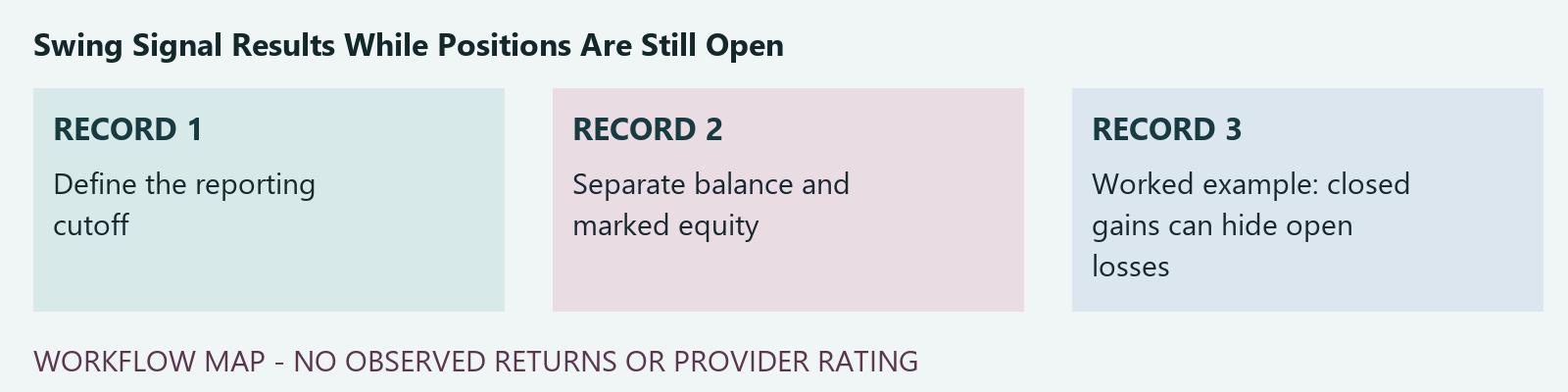
Define the reporting cutoff
State the exact time, timezone and valuation source used to close the review window. A provider may publish on a different clock from the subscriber's account. Keep the original instruction population for the window and retain positions that remain unresolved. A closed-trade summary answers a narrower question than marked account performance. Do not silently move the cutoff until an open loss becomes a winner or omit positions because their intended holding period extends beyond the publication date.
Separate balance and marked equity
Closed proceeds can increase balance while remaining positions create unrealised losses. Identify which quantity the reported return describes. Request the full open inventory and consistent valuations before describing portfolio drawdown or overall account gain. A signal service can publish raw move summaries without specifying capital weights; those summaries must not be relabelled as a subscriber portfolio. The account convention, currency, cash flows and financing remain necessary records even when every original message is available.
Worked example: closed gains can hide open losses
Invent an account starting at 10,000 units, realising 300 of closed trading gain and carrying an open position marked at a 500 loss at the cutoff. Before fees and flows, closing balance is 10,300 while marked equity is 9,800. A closed-gain headline alone would omit the account's current adverse exposure. This example is accounting arithmetic, not a claim about a real provider or an instruction to close the position. The review should show both objects and the valuation uncertainty rather than choosing whichever looks stronger.
Keep partial exits within the position story
Record quantities, fills and the grouping rule for partial closes. A target reached on part of a position does not establish the result for the remainder. Avoid counting each profitable partial exit as a separate successful trade while consolidating a losing remainder into one obscure adjustment. Preserve every material amendment and whether the subscriber acted on it. A later provider stop change does not rewrite the earlier account state or prove a subscriber could have executed the revised instruction.
Include the time-dependent expenses
List borrowing, financing, data, subscription and other costs under the appropriate account and product convention. Do not invent current rates or assume all costs scale linearly with calendar days. Weekends, settlement, currency conversion and broker boundaries can matter differently by instrument. SEC order guidance and performance-reporting standards frame execution and return questions, but the actual broker and source records determine this position's economics. A longer horizon is not proof of easier execution or automatically lower risk.
Use the review to test record quality
A complete swing-signal comparison should reveal the original calls, open inventory, cutoff valuations, charges, partial events and missing records. Distinguish documentation from independently inspected account evidence. This chapter does not create a measured provider leaderboard or test a paid subscription. The blank worksheet supports a bounded review: readers can determine whether a headline describes closed outcomes, open exposure or marked account performance, and which additional artifacts would be needed before drawing a broader conclusion.
Decision record
| Question | Record to retain | Decision boundary |
|---|---|---|
| Cutoff | Exact time, valuation source and open inventory | Open losses cannot disappear from an account claim |
| Return object | Balance, equity or raw signal move | These objects need different denominators |
| Partial close | Quantity, grouping rule and remaining position | A target touch is not a whole-position result |
| Holding cost | Dated account-specific charges and conventions | A long horizon does not make costs irrelevant |
Blank working record
The worksheet contains column headings only. Enter your own dated observations, keep absent evidence marked unknown, and do not treat the file as certification.
 Download worksheet (CSV)
Primary references
These documents support mechanisms and source definitions, not a tested trading result or a recommendation. Accessed 9 October 2026. The decision workflow and invented examples above are editorial exercises.
Keep reading
Publication methodology | Working glossary | Source and correction policy
A worked residual-position example
The new packet makes the existing accounting question concrete. SW-A starts with ten units at one hundred, closes three at one hundred ten and two at one hundred five, then marks five remaining units at ninety-eight. Its forty dollars of realised gross and ten-dollar unrealised loss combine before nine dollars of entered costs are subtracted. The twenty-one-dollar result belongs to that hypothetical position at the supplied cutoff. It is not an annualised return, a provider trade or a promise that the mark was executable.
Try the question on a complete worked lifecycle
The four-position practice packet retains long and short exposure, five recorded exit events, a fixed UTC valuation cutoff and explicit fees and carrying debits. Three positions remain open. Inspect each quantity and mark instead of treating the realised component as the full result. The journal rejects over-exits, absent open marks and exits outside the declared chronology. The separate basket compares entered stop-price losses with entered adverse exits across all four positions. Its cluster labels are illustrative, not measured correlations. Download the populated JSON and CSV records to keep the assumptions with the arithmetic. None of these invented rows belongs to a service in the provider directory, and no output changes the original provider rankings or personal history. A real review would use its own instructions and account records, with the same separation between observations and assumptions.